Softgoods Business & MarketsTKT-CBDE
Cotton Collapse Leaves Nigeria's N1trn Textile Market to Foreign Suppliers
Businessamlive reports Nigeria's N1 trillion textile market now belongs to foreign producers after the domestic cotton base collapsed, shifting the country to import-supplied demand.
- Cut
- October 16, 2026
- Sew
- 2 min
- Ticket
- TKT-CBDE
Construction
Nigeria's textile market is valued at roughly N1 trillion.
Businessamlive reports the collapse of Nigeria's cotton supply base transferred the market to foreign producers.
The failure occurred at the raw-material tier, cutting off local spinning and fabric production.
Demand persists at scale; the supply base shifted to imports rather than shrinking.
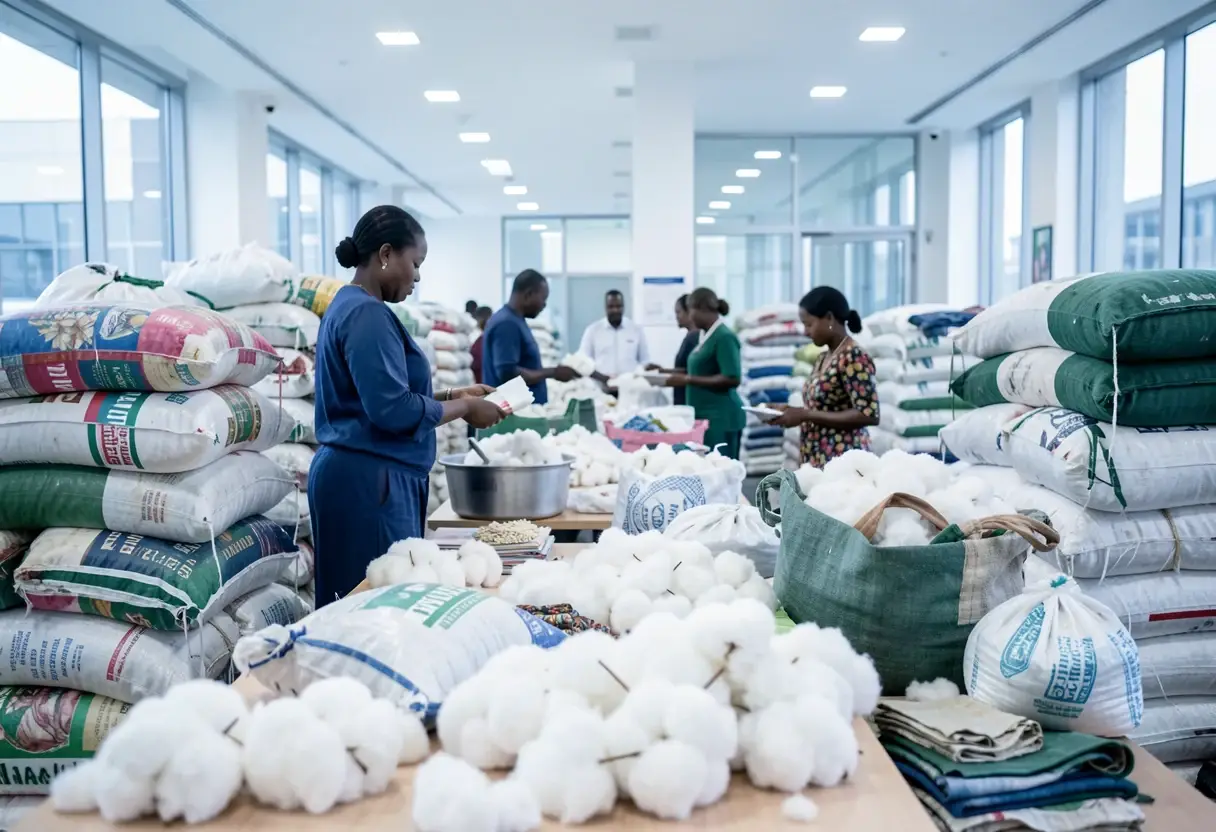
Nigeria's textile market, valued at roughly N1 trillion, has effectively passed to foreign producers after the collapse of the country's cotton supply base, Businessamlive reports. The figure anchors a story about a domestic value chain that stopped feeding its own factories, leaving importers and overseas mills to serve Nigerian demand.
The report frames the outcome in supply-chain terms: the failure sits at the raw-material tier. Without Nigerian cotton flowing to Nigerian spinning and weaving operations, garment and fabric production moved offshore, and finished goods now arrive to capture a market local producers once aimed to hold.
Where did the value chain break?
The break occurred at the first tier, in the fields. Cotton is the input for spinning, weaving, finishing and garmenting, and each downstream stage depends on a reliable, priced-competitively domestic harvest. Once the harvest failed to meet factory requirements, the downstream tiers lost their feedstock.
Mills that cannot source lint locally face a choice: import raw cotton at a cost that erodes margins against finished-fabric importers, or close. Businessamlive's reporting describes the outcome as a market worth about N1 trillion now supplied from outside the country, which indicates that both local spinning and local fabric production have lost their competitive position against imported cloth and garments.
What does the N1trn figure signal for sourcing teams?
A trillion-naira market supplied by foreign producers tells buyers two things. First, demand in Nigeria persists at scale — the market did not shrink; its supply base shifted. Second, the import channel is now the default route for serving it, whether through Asian fabric mills or traders moving finished textiles into West Africa.
For sourcing directors, that shift carries tariff, logistics and currency-exposure implications. Any strategy built on West African cotton-to-garment integration now has to account for Nigeria as an import market rather than a production base, at least until the cotton tier recovers.
Is recovery a policy question or a commercial one?
Both. Cotton revival depends on seed quality, farm economics and ginning capacity — upstream investments with long payback periods. Textile revival depends on whether mills can secure lint at prices that let them compete with imported fabric, much of which enters the market at cost points local producers struggle to match.
Businessamlive attributes the market's transfer to foreign producers directly to the cotton collapse, not to demand-side change. That distinction matters: this is not a story of Nigerian consumers abandoning local textiles, but of local textiles becoming unavailable as the input chain failed.
The decision the news forces
Sourcing teams serving Nigeria must decide whether to treat the country purely as an end market supplied through import channels, or to track any credible upstream cotton-recovery programme as a longer-term nearshoring option. Compliance and market-intelligence desks, meanwhile, should monitor Nigerian trade policy on textile imports, since a government responding to a lost N1 trillion industry often reaches for tariffs or smuggling enforcement next.
via Google News: Textile industry (Source)
More from Grace Kim
Show full bio
Correspondent covering regulation, policy and their impact on Light industry and softgoods manufacturing at Softgoods Report.
318 articles