Trade & Sourcing PolicyTKT-D06F
Asia Port Congestion Could Take 10 Months to Clear, Sea-Intelligence Says
Sea-Intelligence projects 7-10 months to clear Asia port congestion as record Chinese volumes tie up 3-3.8 million TEUs. Shanghai on-time performance has fallen to 21%.
- Cut
- October 10, 2026
- Sew
- 4 min
- Ticket
- TKT-D06F
Construction
Sea-Intelligence projects 7-10 months for Asia port congestion to return to mid-2025 calm conditions.
Chinese ports handled a record 7.3 million containers in the week through Sept. 20, up 9% year over year.
Congestion has tied up roughly 3-3.8 million TEUs, or 8.5-11% of the global container fleet.
Shanghai on-time performance has fallen to 21%, with berthing waits exceeding five days.
Carriers blanked nearly 13% of Asia-U.S. and Asia-Europe capacity around Golden Week, Oct. 1-7.
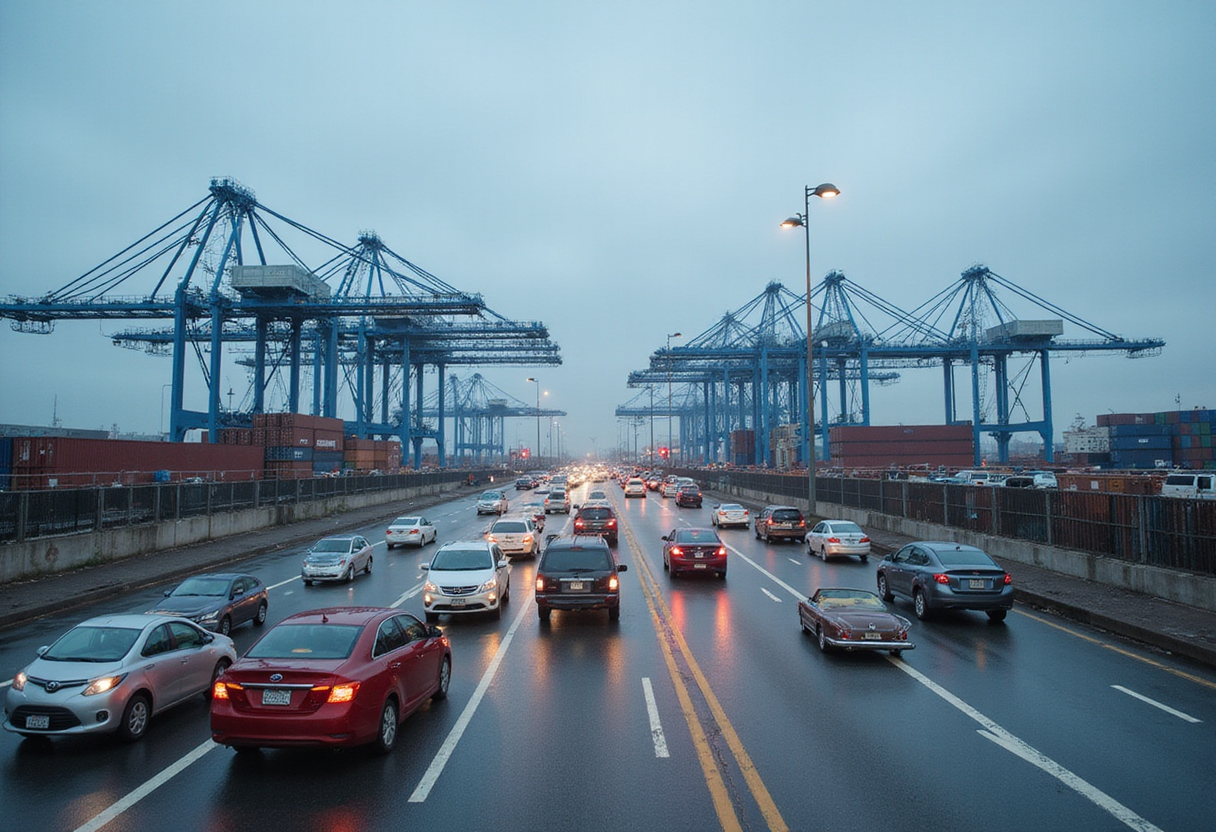
Asia's container shipping network could take seven to 10 months to clear its current congestion backlog, according to container shipping research firm Sea-Intelligence, pushing normalisation beyond February's Lunar New Year and into next summer for apparel and soft goods shippers moving production out of China and Southeast Asia.
Even a return to end-2025 conditions could take six to eight months, Sea-Intelligence projects. The timeline applies to the Asia-origin ocean freight tier that underpins most garment and footwear sourcing from China, Vietnam, Thailand and Indonesia.
How bad is the backlog right now?
The congestion has tied up an estimated 8.5% to nearly 11% of the global container fleet — roughly 3 million to 3.8 million TEUs — according to respective data from Linerlytica and Sea-Intelligence.
Chinese ports handled a record 7.3 million containers in the seven days through Sept. 20, up 9% from the same week last year, according to China's Ministry of Transport data analysed by Bloomberg. Volumes rose about 6% year over year in each of the first two weeks of September.
The pressure follows typhoon disruption and an August in which Chinese exports rose 25% year over year while imports jumped 28.2%. Economists surveyed by Bloomberg now expect China's exports to grow 17% this year and imports to rise 22%.
What are the ports reporting?
Freight forwarder Dimerco's October Asia Pacific Freight Report lays out the operational detail:
- Shanghai: berthing waits of more than five days, exceeding nine days at the Waigaoqiao terminal; on-time performance down to 21%. Severe congestion expected into mid-to-late October.
- Ningbo: China's second-busiest gateway, at 34.6% on-time performance.
- Qingdao: carriers have cut allocations and skipped calls to clear typhoon backlogs at southern ports.
- Yantian (Shenzhen): a 120% container receiving cap imposed on Aug. 26 — once a voyage's intake hits 120% of the vessel's baseline capacity, no new export loaded containers are accepted. Appointment slots fill within seconds during peak periods, and empty-container releases are limited, adding to equipment shortages.
What is happening to rates?
Spot rates are climbing. Drewry's Intra-Asia Container Index rose 6% week over week to $1,491 per 40-foot container on Sept. 24, its fifth consecutive record high. Shanghai-to-Laem Chabang rates jumped 22% to $1,609 per box; Shanghai-to-Jakarta climbed 12% to $2,300 on average.
Carriers have blanked just under 13% of planned Asia-to-U.S. and Asia-to-Europe capacity around China's Golden Week (Oct. 1-7), Dimerco reports — with cancellations announced on shorter notice than last year.
"Everyone expected October to mark the start of the slowdown, but the cargo hasn't stopped and the overflow is still rolling forward," Ted Chen, Dimerco's executive vice president of global sales, said in the report. "With carriers blanking sailings at short notice, the real risk isn't port congestion, it's space disappearing before you've booked it."
Does the truce change the outlook?
The flows may accelerate. Bloomberg reported the record week through Sept. 20 may have reflected shipments moving ahead of the Trump-Xi summit, which extended the U.S.-China trade truce from Nov. 10 to Jan. 10, 2027. Both countries plan to cut tariffs on $60 billion worth of goods under the extension.
Dimerco expects elevated volumes into the fourth quarter, with China-to-U.S. shipments held back by earlier tariff uncertainty releasing just as the normal Q4 peak builds. "Bookings look quiet right now, but that's the calm before the door opens," said Kathy Liu, Dimerco's vice president of air freight. "Once held-back China-U.S. cargo releases and ocean congestion pushes shippers into air, the space will face some constraints."
What should sourcing teams do?
Dimerco advises booking intra-Asia ocean freight one to two weeks ahead of schedule and long-haul shipments two to three weeks ahead. Sourcing managers should treat the January truce deadline as a hard planning constraint: held-back cargo, blanked sailings and a 10-month congestion tail mean lead-time buffers and confirmed allocations — not rate speculation — are the decisions this news forces now.
via Sourcing Journal (Source)
More from Olivia Hart
Show full bio
Senior reporter covering regulation, policy and their impact on Light industry and softgoods manufacturing at Softgoods Report.
227 articles