Trade & Sourcing PolicyTKT-4838
Suez Container Traffic Passes Half of Pre-Attack Level as Carriers Return
Suez container transits hit 753,000 TEUs weekly in early October, above half of 2023 levels, but war-risk premiums near 3 percent and Houthi strikes on Saudi airports keep the return fragile.
- Cut
- October 14, 2026
- Sew
- 4 min
- Ticket
- TKT-4838
Construction
Weekly Suez container transits reached ~753,000 TEUs in early October 2026, vs. 1.457 million TEUs in the same 2023 period (Clarksons).
More than 140 container ships, over 2 million TEUs of capacity, have switched from Cape routing since May (Linerlytica).
Drewry pegs the Suez saving at ~$1 million per round voyage for 24,000-TEU ships before war-risk insurance; Bab el-Mandeb premiums hold near 3 percent.
A Houthi missile struck Riyadh's King Khalid International Airport on Saturday, killing 13 and wounding over 300.
Sixteen services have announced Suez returns since early July across all three major alliances and MSC (BIMCO).
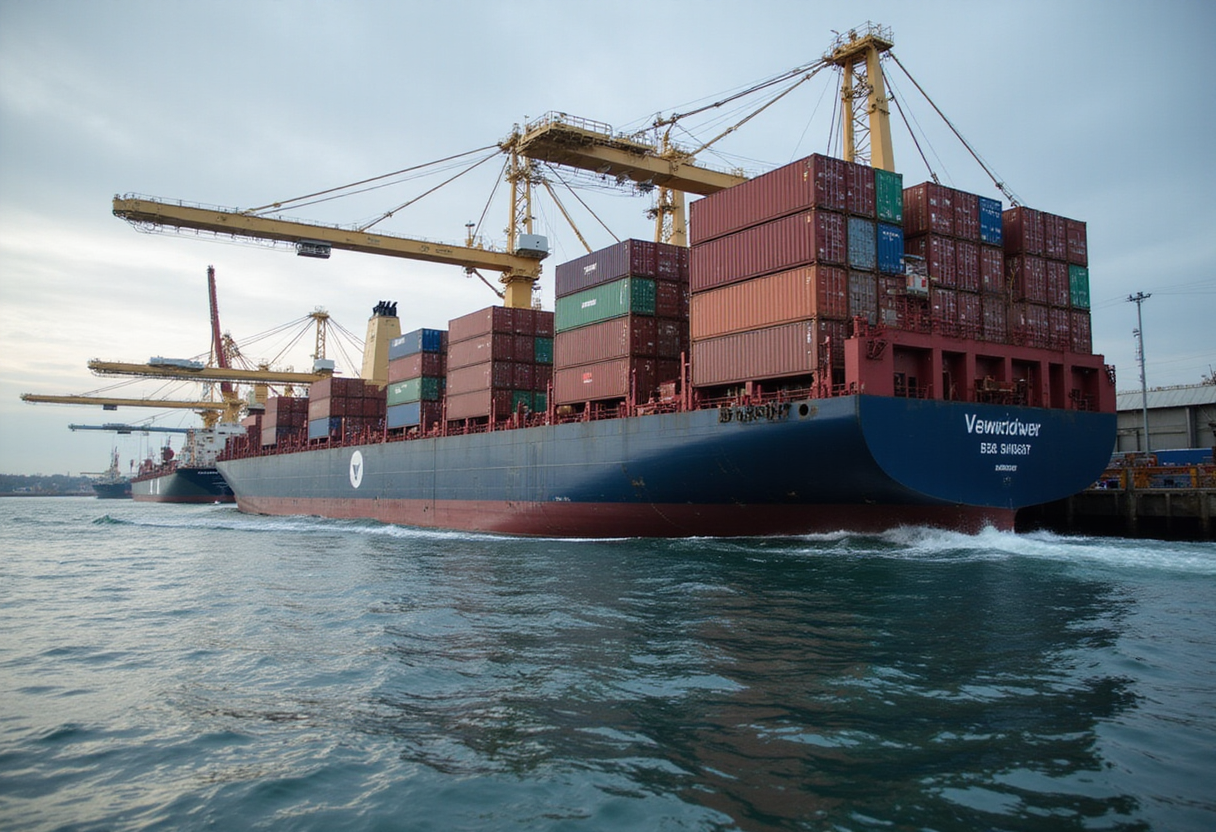
Container traffic through the Suez Canal has climbed past half of its pre-disruption level for the first time since Houthi attacks forced carriers around Africa. Weekly transits reached roughly 753,000 TEUs in the first two weeks of October, against 1.457 million TEUs in the same period of 2023, according to Clarksons Research.
The recovery is steep by any measure. At the trough, from February 2024 through mid-2026, weekly transits averaged just 141,000 TEUs, or 11 percent of 2023 levels. Clarksons now counts 36 percent of container capacity routed via the canal or the Cape of Good Hope traversing the Suez in early October, up from 8 percent between 2024 and mid-2026 — though still below the pre-attack share of 80 percent.
Linerlytica data backs the shift. Roughly 29.5 container ships over 4,000 TEUs passed through the Suez and Bab el-Mandeb Strait between Aug. 31 and Sept. 27. That rose to 45 vessels in the week of Oct. 5-11, with about 47 projected this week, and Linerlytica expects transits to breach 50 per week soon. The firm estimates more than 140 container ships, over 2 million TEUs of capacity, have switched away from Cape routing since May.
Who is moving back, and how fast?
Suez Canal Authority chairman Ossama Rabiee said 166 medium and mega container vessels used the canal between July and September 2026, totaling 29 million net tons — against 16 vessels and 2.4 million tons a year earlier.
Sixteen services have announced Suez returns since early July, according to shipping association BIMCO, spanning all three major vessel-sharing alliances (Gemini, Ocean and Premier) plus Mediterranean Shipping Company. This week the Premier Alliance of ONE, HMM and Yang Ming added its FE1 Asia-North Europe service, the coalition's first Red Sea return since diversions began.
Linerlytica expects a full-scale Suez return within the first quarter of 2027; Drewry projects a phased return reaching 80 percent of pre-diversion levels by February, skewed toward backhaul voyages as carriers test the route.
What does the economics look like?
Drewry's September 2026 comparison puts the Suez saving at roughly $1 million per round voyage, or $43 per slot, for 24,000-TEU ships on Asia-North Europe — before war-risk insurance and canal discounts.
Insurance can erase that margin fast. On a $225 million hull, a one-way war-risk premium of 0.3 percent adds $1.35 million per round voyage, enough to tip the advantage back to the Cape. A 1 percent premium would add $4.5 million and likely dictate Cape routing. Premiums for Bab el-Mandeb transits have held at roughly 3 percent since early September, according to Reuters.
The rush back also pressures rates. Drewry cited the quicker-than-expected Suez resumption as the biggest risk to carriers' rate recovery, since shorter transits effectively add capacity to the Asia-Europe lane. Freight rates on the route have fallen for 13 consecutive weeks.
"The critical question is therefore not whether Suez is cheaper than the Cape on a single round voyage," said Simon Heaney, senior manager of container research at Drewry, in a Sept. 30 forecast. "It is whether the annual value of recovered vessel capacity, shorter transit times, improved schedule economics and competitive positioning exceeds the expected cost of a security disruption."
Heaney read the industry's behavior less as conviction that the Red Sea is safe and more as controlled experiments that retain contingency plans to revert to the Cape.
Is the security risk priced in?
The threat has not gone away. Heaney noted the Houthis have recently strengthened their position along Yemen's Red Sea coast, gaining greater leverage over the Bab el-Mandeb Strait.
The wider conflict escalated on Saturday, when a Houthi ballistic missile struck the passenger terminal of Riyadh's King Khalid International Airport, killing 13 and wounding more than 300. Houthi spokesman Yahya Saree claimed further strikes on Dammam's airport and two Aramco facilities, and warned international travelers, companies and workers against using Saudi airports and airspace — with direct routing implications for air cargo.
Lars Jensen, CEO of Vespucci Maritime, wrote on LinkedIn that the attacks "illustrate a risk I am not sure is fully taken into account by the supply chain stakeholders." He added: "The Houthis could shut down container traffic via the Red Sea and cause a reversal to round-Africa at any time of their choosing. Right now they choose not to."
Andrew Moulton, chairman of the Joint War Committee, told the CSN Maritime Forum in London that the Houthis "have issued statements to several shipowners saying that 'you are not on our target list,' but it's difficult to know how sophisticated they are at being able to target vessels or not target vessels, especially when the AIS may be switched off."
For sourcing teams, the decision is now hedging, not switching: Suez transit cuts roughly $1 million per round voyage on Asia-North Europe, but a single security event can force an instant reversion to Cape routing, adding transit time to goods in transit. Shippers should price that contingency into spring 2027 delivery schedules rather than treat the Red Sea as restored.
via Sourcing Journal (Source)
More from Grace Kim
Show full bio
Correspondent covering regulation, policy and their impact on Light industry and softgoods manufacturing at Softgoods Report.
275 articles